COBRAPOST EXCLUSIVE: Whistle Blower Busts Manoj Agarwal's nexus with Kamla Pasand - Part I
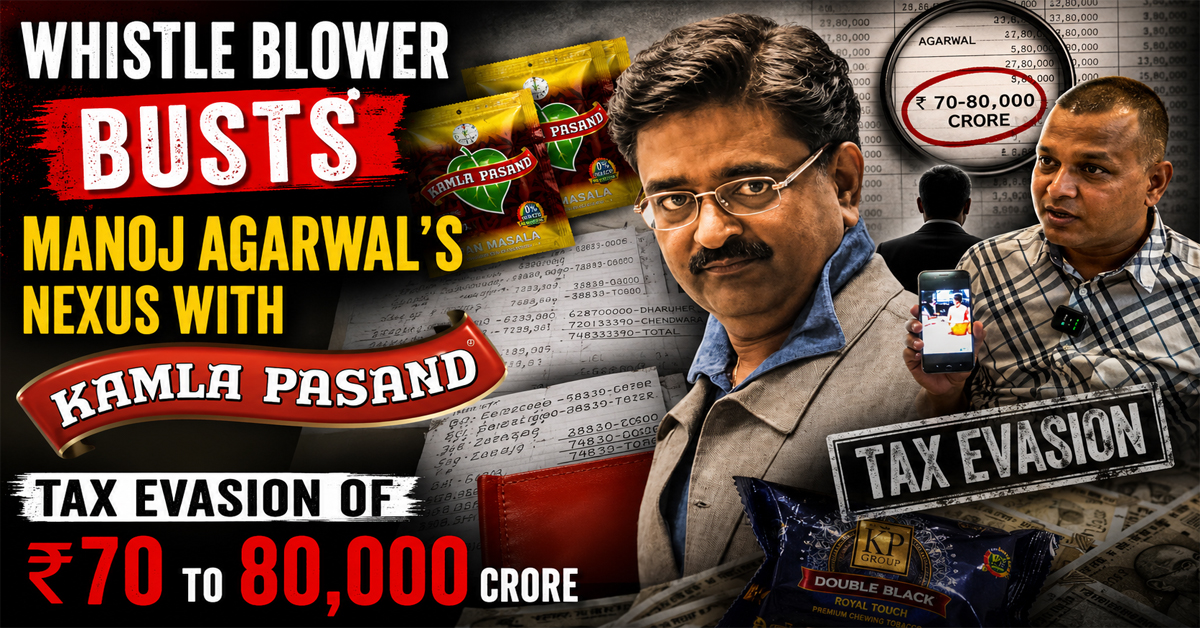
Cobrapost (New Delhi): Sometime back, a whistleblower approached Cobrapost through some sources with damning evidence involving Manoj Kumar Agarwal, a businessman hailing from Kanpur, Uttar Pradesh. Agarwal is a betel nut trader supplying betel nut, tobacco, and fragrances, among other ingredients used for manufacturing pan masala. He supplies mainly to the Kamla Pasand Group, the pan masala manufacturer from Kanpur. Agarwal's empire is spread across several states – Uttar Pradesh, Delhi, Haryana, Madhya Pradesh, Chhattisgarh, Maharashtra, West Bengal, and Assam. However, his business empire is built on subterfuge, manipulation, and creative accounting with the sole objective of tax evasion. He deploys a unique modus operandi where almost all business is run through dozens of corporate entities or partnership firms registered in the names of proxies. Benami owners, in other words. The raw betel nut is sourced from down south, processed in Gurgaon, and dispatched to various centres such as Raipur, Indore, Nagpur, Kolkata, and Guwahati. Business transactions are conducted in cash running into hundreds of crores of rupees. The cash thus generated is moved through individuals, deposited into bank accounts of these firms. If cash was deposited at a Kolkata bank, it would be moved from there to Nagpur, from Nagpur to Delhi and from there to Agarwal's Gurgaon firms.
Agarwal might have revenues worth Rs. 60,000 crore during their six-year-long business association. Understandably, the layered mechanism devised by Agarwal was designed to keep all transactions unaccounted and evade taxes. These facts have emerged from a one-and-half hour-long interaction Cobrapost had with Kush Jaiswal, the whistleblower.
Here is a summary of the modus operandi Manoj Agarwal deployed:
- Business operations were run through proxy entities in their entirety
- Cash sale proceeds running into hundreds of crores of rupees were deposited in the bank accounts of those proxy firms at his various distribution locations
- Money from there was ploughed back to his firms through RTGS in a circular manner.
- The bulk of the betel nut trade was conducted off-the-books in an apparent bid to avoid tax.
We begin our interaction with the whistle blower asking about his association with Manoj Agarwal, when they met, and what role he played in Agarwal's business. Jaiswal was introduced to Agarwal at his Nayaganj office in Kanpur by one of his friends called Vikram Soni sometime around 2017. Soni has long been associated with Agarwal and supplies calcium gluconate to his factory in Kanpur. This meeting followed by two more. In one such meeting, Agarwal asked Jaiswal if he was interested to work with him. Who would miss a business opportunity? So, when Jaiswal agreed, Agarwal asked him to set up a company in Meerut in someone else's name for his betel nut trade. Thus was born Satguru Traders, registered in the name of Prakhar Singh, the son of one of Jaiswal's friends. Agarwal generated a business worth around Rs. 70–80 crore in a matter of seven-eight months through this entity. The business got busted when the Special Investigation Bureau of state GST Department raided the Meerut factory. Agarwal asked them to shut down the firm and never bothered to help the embattled Prakhar Singh in whose name the entity was registered and ran its business. Interestingly, Jaiswal never saw a single piece of betel nut. "Unki firm mein unhone sattar-assi karod rupaye ka kaam kiya aur unhone maal kharida aur becha aur maal kahan gaya, maal ka kya hua hamein iss baare mein koi jaankari nahin thi," Jaiswal tells Cobrapost in a matter-of-fact manner.
Jaiswal shared his first-hand experience working with Agarwal, who operates behind the shadows, using front men like Prakhar Singh. Agarwal completely dumped Prakhar Singh, the proxy owner of the Meerut entity, when things became too hot to handle after the raid.
Jaiswal met Agarwal, his close associate, and Subodh Agarwal, among others in a Delhi hotel. Here, Agarwal laid out the entire plan: how Jaiswal and others will help him build his betel nut trade. The basic purpose of his business operation was to supply betel nut to the Kamla Pasand Group. Jaiswal and Subodh Agarwal were tasked with setting up around 10 firms spread across five centres – Delhi, Gurgaon, Nagpur, Indore, and Kolkata. According to the plan, none of these entities were supposed to cross transactions of Rs. 100 crore to avoid scrutiny and legal trouble. As soon as an entity reached a turnover of Rs. 100 crore, it was to be dissolved. was supposed to work as a liaison to trouble shoot exigencies arising out of situations when government officials came knocking. Seizure of vehicles and raids, for instance. Nothing gets more interesting to hear when Jaiswal reveals, "... toh yah kahani wahan se shuru hoti hai aur wahan unhon ne hamein bataya ki ab Kamla Pasand ke liye ham supari kee supply ka kaam start karenge." The basic purpose of the plan was to supply betel nut to the Kamla Pasand Group and Jaiswal, , and Subodh were roped in as partners by Agarwal.
After the Delhi meeting, Jaiswal began working for Manoj Agarwal. As part of the modus operandi, two firms each were set up in Delhi, Gurgaon, Nagpur, Indore, and Kolkata. The goods, betel nuts in this case, moved from South to Delhi, from Delhi to Gurgaon, from Gurgaon to Nagpur, and from Nagpur to finally Kolkata. After three-four months when each of these firms began to see a monthly turnover ranging from Rs.10 crore to 20 crore, Jaiswal was allegedly introduced to creative accounting by Agarwal. When Jaiswal asked him how they should go about making payments to companies from down south, Agarwal told he would provide contact details of certain individuals from Nagpur and Kolkata. These individuals would supply cash against which Jaiswal was supposed to create bills of Rs. 40,000 each equal to the amount of cash received. For instance, if they supplied betel nut to a firm in Nagpur to the tune of Rs. 10 crore, he was supposed to create bills showing as much cash received in sale proceeds. But what about the stock lying thereabout in the godown, Jaiswal wondered. This is what Agarwal allegedly told him: "Toh unhone kaha jaise-jaise tum cash ke bill katate jaoge, vaise vaise number doh mein godown se utna hee stock utha lenge to tumhari books ka milaan aur godown ke stock ka milaan parallel rahega."
After the raw betel nut sourced from down south was cut and processed, it was sent to Nagpur and Kolkata by, respectively, Vidya Sagar Roadways and Bikaner Assam Transport. Anil Jain and Sachin Chaudhary helped with this task. All transactions were conducted in hard cash. When Jaiswal raised concern about how they would manage such bulk cash, Agarwal assured him there was no such provision yet as would stop sale of products in cash. After the fake bills were created and the material was shipped accordingly, Vijay Kumar Jain in Nagpur, Anil Kumar Pandey in Kolkata, and some other individuals in Guwahati stepped in to provide cash against the sale of processed betel nut which would run into crores of rupees. Manoj Agarwal already had arrangements with certain private banks such as IndusInd Bank, HDFC Bank, and Kotak Mahindra Bank, among others. The cash was moved from those banks backward in the same way as processed betel nut was shipped forward – from Delhi to Gurgaon, from Gurgaon to Nagpur, and from there to Kolkata. Once the cash in bulk was deposited in the bank accounts of the firms registered there, RTGS was used to plough the cash back – from Kolkata to Nagpur, from Nagpur to Delhi, and finally from there to Gurgaon firms. "Nahin, yah nakad mein jama hua nakad mein kyonki Kalkatta mein hee bikri dikhayi gai. Toh nakad Kalkatte ke khaate mein jama hua cash bikri kee evaj mein. wo paisa Nagpur aaya RTGS ke dwara aur Nagpur se Gurgaon aaya RTGS ke dwara, Gurgaon se Dilli aaya RTGS ke dwara aur Dilli se wo paisa South kee party ke paas chala gaya ... wo supari kharidi thee," thus explains Jaiswal the movement of money once the cash found its way into regular banking channels.
Jaiswal made another important revelation during the course of our interviewwith him. Truckloads of betel nut were bought from the South in the name of the two Delhi firms and were kept in warehouses in Bakoli, Narela, and Alipur, among other places. All outskirts of Delhi. These warehouses were owned by Manoj Agarwal, his partner Jai Prakash Sharma, and the Kamla Pasand Group. But the story is not as simple as it sounds. There are many twists in the tale. If they got a truckload of the nut accounted for, there were tens of truckloads lying in these warehouses. All unaccounted. The truckloads were shipped to Gurgaon-based factory owned proxy by Manoj Agarawal by Bikaner Assam Transport using a single e-way bill. The factory, which he calls dummy, was equipped with all necessary paraphernalia to hoodwink the government agencies. The real cutting and processing took place in the factories in immediate vicinity which were owned by the Kamla Pasand Group. "Toh Dilli ka jo pattern tha wahi pattern Gurgaon mein bhi tha. Crusher ke saath-saath Manoj Agarwal aur Kamla Pasand wale ka godam aur ek bada crusher laga hua tha jahan actual supari katati thi," Jaiswal tells us
As Jaiswal reveals, around 10 truckloads of nut were shipped to Gurgaon by SK Bothra's transport company on a single e-way bill in a span of 48 hours before it expired. According to Jaiswal, Bothra's transport company is the backbone of Agarwal's business operations. This is what he tells us: "Vey kya karte theiy ek gaadi ka bill jaise aaj Gurgaon ke liye Dilli se khadi supari transport kee jaani hai. toh ek gaadi ke liye e-way bill banaya gaya, e-invoice banaya gaya aur transporter unka mukhya backbone transporter hai Bikaner Assam Transport. is khel ka poora channerl SK Bothra ji dwara sanchalit kiya jaataa hai (What they would do? Suppose a truckload for Gurgaon has to be dispatched, a bill was created from Delhi. One e-way bill, an e-invoice was created and their main backbone is Bikaner Assam Transport. The whole channel is run by SK Bothra)." "
A single e-way bill, e-invoice, and bilty (consignment invoice) would be created from a Delhi firm owned by Agarwal. The consignments would, however, be picked not from the warehouses of the Delhi firms but from other warehouses owned by Agarwal's dummy firms. Such as those at Nangli Puna where heaps of unaccounted nut were stored. Finally, few hours before the expiry of the e-way bill, one truckload of accounted nut would be shipped to the Gurgaon dummy crusher to give an impression that the factory was operational all the time. Jaiswal claims that the Central GST had raided the premises and godowns of Anjaneya Traders LLP sometime in 2022–23. The raids led to seizure of around one lakh and a quarter of unaccounted sacks of betel nut. The worth of the seized betel nut, according to him, was estimated anything between Rs.500 crore and Rs. 700 crore. This is how they operated using a single e-way bill: "Ab dekhiye meri firm se ek gaadi ka bill bana aur ek gaadi load kari toh wah bill Manoj kee firm, dummy firm se dus chakkar maarti thi kyonki samay seema antalees ghante kee thi aur Dilli se Gurgaon factory maal pahunchne mein jyada se jyada teen se chaar ghanta. toh gaadi uthati, vahan maal fenkati, fir wapas jaati, fir maal load karti. toh ek e-way bill par antalees ghante ke andar-andar ye aath se das chakkar lagaa lete theiy."
In a nutshell, for one truckload of raw nuts shipped to Gurgaon properly accounted, nine truckloads of unaccounted raw nuts were slipped in using a single e-way bill. The same modus operandi was used for the supply cut and processed betel nut to Raipur, Indore, Nagpur, and Kolkata. Usually, an e-way bill for long-haul shipping expires in 18 days. An important cog in the wheel is SK Bothra of Bikaner Assam Transport. Bothra's transport company is rather the backbone of Agarwal's business operations. Its smart drivers would complete a trip to these far-flung distribution centres in a matter of 12–14 hours. This shorter turnaround time helped them make more number of trips to these distribution centres. It is interesting to note that the Kamla Pasand Group had a franchise arrangement with Manoj Agarwal's companies in Gurgaon and other distribution centres. All these franchisees were supplied processed betel nut from Kamla Pasand Group's Gurgaon crusher. This is how the franchise arrangement worked: "Exactly, yah ek franchisee thi. ye Kamla Pasand ko vastavikata mein bhi supari deti thi franchisees ko aur jo Manoj Agarwal kee company wo sab jitni franchisee hain India bhar mein wo sabka maal usi cursher mein katataa tha aur usi crusher se poore India bhar mein jaata tha maal."
While interacting with Jaiswal, we notice a certain amount of anxiety in his body language, like a man looking over his shoulders. It is shocking to know that after parting ways with Manoj Agarwal, a vicious campaign of harassment has been orchestrated against Jaiswal. FIRs have been slapped against him, his wife, his relatives, and partners both at Daruhera and at Chhindwara, under BNS sections 61(2), 316 (5), 318(4), 338, 336(3), and 340(2). He alleges he has been hounded by Haryana police and attempt to arrest him has been made. His movements are being monitored and his residence in Lucknow is under surveillance by unidentified men in vehicles. Jaiswal says he is facing a grave threat to his life from both Kamla Pasand and Manoj Agarwal. He moves from one hideout to another hideout for obvious reasons. It is for this reason he met us at a secret rendezvous for the interview where he exposed all machinations and manoeuvres Agarwal deployed to run his business empire while remaining behind the shadows.
According to Jaiswal, this cycle of harassment, intimidation, and inimical retribution began after he shut down the Daruhera factory in January 2025. What Jaiswal tells us next would sure send a chill down your spine: "Mere ko yahan pe itni reccee yani ke meri kee gai even Haryana Police mujhe arrest karne aai. meri unse bhi meri kaafi bahasa-bahsi hui aur yes sab hua. Main kisi tareeke se bach ke nikla nahin toh main toh maar hee diya jata. aur aaj bhi lage hue hain hamein maar dein chaahe Manoj Agarwal hon ya Kamla Pasand hon poori tareeke se wo chaah rahe hain mera ant ho jaae taaki mere paas jo documentary evidence hai main kahin na de paaoon."
The modus operandi which Manoj Agarwal deployed had the following components: business operations were run through proxy entities in their entirety, cash sale proceeds running into hundreds of crores of rupees were deposited in the bank accounts of those proxy firms at his various distribution locations, and from there it was ploughed back to his firms through RTGS in a circular manner. The bulk of the betel nut trade was conducted off-the-books in an apparent bid to avoid tax.
As the interview moved further, Jaiswal meticulously weaved the various components of Agarwal's business operations. Ninety percent business was kept off the books and the prices of nut procurement was kept half the original billing amount to evade tax. Agarwal might have conducted a business worth around Rs. 60,000 crore in this manner during six years of Jaiswal's association with him. Vijay Kumar Jain helped him move cash running into crores through hawala.
Such illegal activity as shipping truckloads of goods on a single e-way bill is not possible without acquiescence and active cooperation of the government officials. It is obvious that the passage at the border tax posts of various states was granted at the behest of the transporter for regular consideration. Similar is the case with Central GST Department. Jaiswal has provided us off-the-book accounts or 'kacche ka hisab’ supported by bank statements for Daruhera and Chhindwara factories. Jaiswal had set up these factories for nut processing in his kin's names at Agarwal's behest. Documents pertaining to the Daruhera factory show monthly under-the-table payouts to officials of GST and Central Evasion departments. There are other regular expenses like diesel purchases. But here again, the same pattern followed. Even as Agarwal managed to keep taxmen amused by greasing their palms, the loads of cash that unaccounted sale of betel nut produced was couriered to him through hawala operators. Jaiswal identifies Vijay Kumar Jain of Raipur who would dispatch cash from Nagpur sometimes running into Rs. 10 crore in compact vehicles such as Scorpio. Similarly, the business operations of the Meerut entity, Satguru Traders, he recollected, was an exercise in money laundering as he never saw single piece of betel nut. Brace up for the bombshell. "Ye toh ye poora kaam hawala ke dwara hee hota tha. ab jaise wahan inke Raipur se Vijay Kumar Jain hain. Ab wo hawala operator hee honge, tabhi toh hamein bulk mein cash dete the. Wahan se doh-doh karod, chaar-chaar karod, paanch-paanch karod kee gaadiyan aati thin wahan se. jaise ki Scorpio wagairah mein bhar ke dus-dus karod rupaye aate theiy Nagpur mein," Jaiswal recalls.
Like in the case of Prakhar Singh of Satguru Traders, Agarwal beguiled Jaiswal into setting up two factories. He assured Jaiswal that now onward all business transactions would be "pakke ka", which meant every dime of sale proceeds would be accounted for, Jaiswal set up two factories. One was Shri Sai Enterprises in Daruhera of Haryana, where his wife Renu Jaiswal and were partners. Six months later, resigned from the firm. The other Shree Rudra Overseas was set up in Chhindwara of Madhya Pradesh where Jaiswal's brother-in-law Manoj Kumar Jaiswal was proprietor. There again the same pattern was followed. For every 30–35 truckloads of processed nut accounted for, 300 truckloads were dispatched "kacche mein" or unaccounted. Listen what he tells us: "Aap samjh rahe hain jaise tees-paintees gadiyaan pakke taur par gain, yani bill ke jariye aur tees-paintees gadiyon ke evaj mein kam se kam teen sau gadiyaan number doh mein, das guna jyada pakke taur par gain (You understand; for instance, 30–35 truckloads were shipped duly accounted for, which means with proper billing, and against these 30–35 truckloads at least 300 truckloads of unaccounted goods were dispatched)."
Jaiswal alleges Manoj Agarwal and Dinesh Jaiswal would take charge of the Daruhera factory after he left for the day. It was in the night the "kacche ka" production was done under their supervision using diesel generator to power the operation. Jaiswal has kept records of all business transactions conducted during the six years of his association with Agarwal which according to him could be in the range of Rs. 3000 crore to Rs. 3500 crore. This is what he told Cobrapost: "Mere paas doh hazar attharah se doh hazar chaubees disamber last tak ki jo balance sheet hai uspe main cash jo Manoj Agarwal ne hamko receive karaya vo kareeban teen se saadhe teen karod ka hai, teen se saadhe teen hazar karod kee receiving main dikha doonga."
It is obvious from Jaiswal's averments and the chronology of events, with documentary evidence to substantiate, Manoj Agarwal and the Kamla Pasand Group are hand-in-glove while orchestrating the scam of this scale. The 2019 seizure of a truckload of unaccounted processed nut shipped to their Nadarganj pan masala factory in Lucknow by the mobile squad of the Uttar Pradesh GST Department is a case in point. If we take into account the total quantum of nut sold off the books by Agarwal, which according to Jaiswal is 10 times the actual accounted supply, the total sale proceeds could be estimated at a staggering Rs. 30,000 crore during this period. But here again it does not provide us a complete picture of the total turnover of Agarwal's betel nut trade. The main objective behind this subterfuge was to evade tax. Betel nut attracts 5 percent tax. So, another device Agarwal used was under-invoicing. He would source betel nut from the South but would pay his suppliers only half through billing. The rest would be paid cash. He must have thus raised a cash revenue of Rs. 60,000 crore in this manner. "Bill per supari aati hai teen sau rupaye kilo. aap uss supari kee valuation kara lijiye vo chhei sau rupaye kilo se kam kee nahin hai supari. ab tees hazar karod automatically saath hazar karod mein convert ho gaya kyonki billing aadhi hoti hai," Jaiswal explains. Understandably, the cash was moved around through hawala and slipped into the banking channels as cash sale proceeds.
It is interesting to know that Agarwal and his associates used a code language while discussing business transactions on WhatsApp. A kg, a packet, or a box denoted rupees in lakh – 50 box meant Rs. 50 lakh and 500 box meant Rs. 5 crore. Does it ring a bell? Yes, those villains in Bollywood flicks would use this language.
Before going public with the interview, Cobrapost had sent detailed questionnaires to both Manjo Agarwal and the Kamla Pasand Group. But they failed to respond.
Watch this space for the next part of the inverview.
Disclaimer:
The disclosures, claims, and opinions expressed herein are solely those of the whistleblower. Cobrapost assumes no liability or responsibility for any unverified statements made by Kush Jaiswal during the course of this interview.
Transcription and translation of video-taped content are complex processes subject to human error; however, every effort has been made to ensure accuracy.
If you like the story and if you wish more such stories, support our effort Make a donation.
Trending News
Tue Jul 21 2026 | By Newsdesk
Tue Jul 21 2026 | By Newsdesk
Tue Jul 21 2026 | By Newsdesk

Tue Jul 21 2026 | By Newsdesk
Tue Jul 21 2026 | By Newsdesk